Multi-DOF Finger & Hand Designs
An ongoing series of CAD explorations in Onshape, iterating on finger mechanisms from simple 3 or 4-DOF designs to a full 20-DOF dexterous hand.
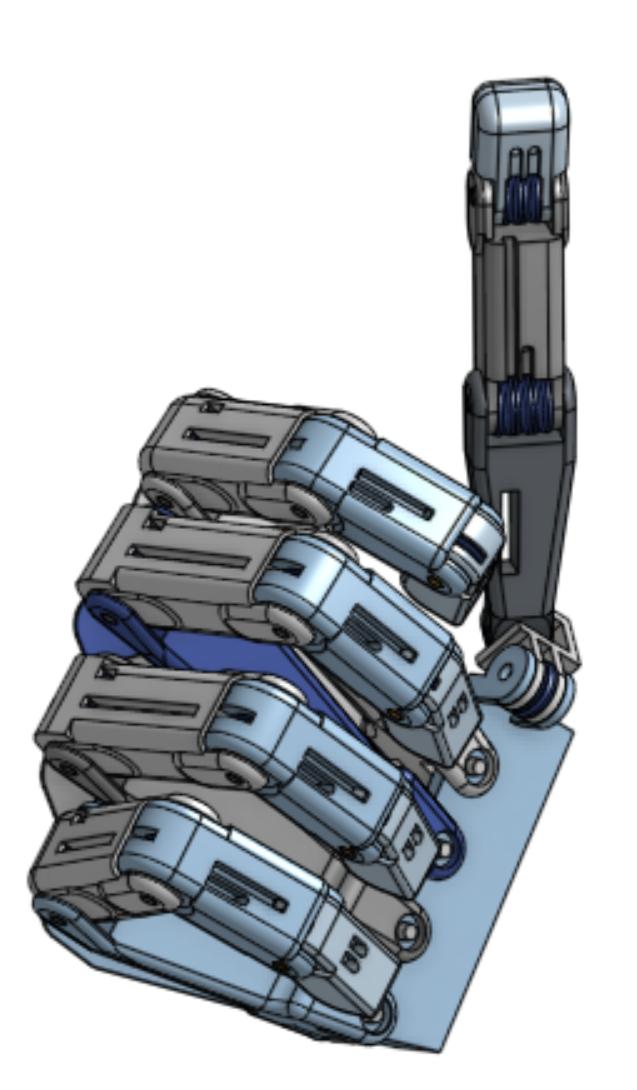
[20 DOF Hand in Onshape Assembly]
Motivation
After building and actuating the Articulate Mechanical Digit, After my initial exploration of dexterous design, I wanted to dive into the mechanical portion further by exploring different joint configurations, tendon routing strategies, and finger geometries purely in CAD before committing to prints and hardware. Each iteration tested a different idea about compactness, range of motion, or manufacturing feasibility, eventually leading to a 20-DOF hand concept.
Design Iterations
3-DOF Underactuated Low Profile
This design experimented with insetting the tendons, and underactuating the joints by using a single extension and flexion tendon. This design utlilized same-radius pulleys for each joint, insuring that the total change in length of the flexion tendon matches that of the extension tendon for all angle changes. This is done so that both tendons can be connected to a single actuator for simplicity.
While this design was simple to actuate and had low friction, it sacrificed dexterity by coupling all joint movements together with a single tendon. Furthermore, the individual joint angles were not controllable, instead, only the sum of the angle changes across all joints was controllable.
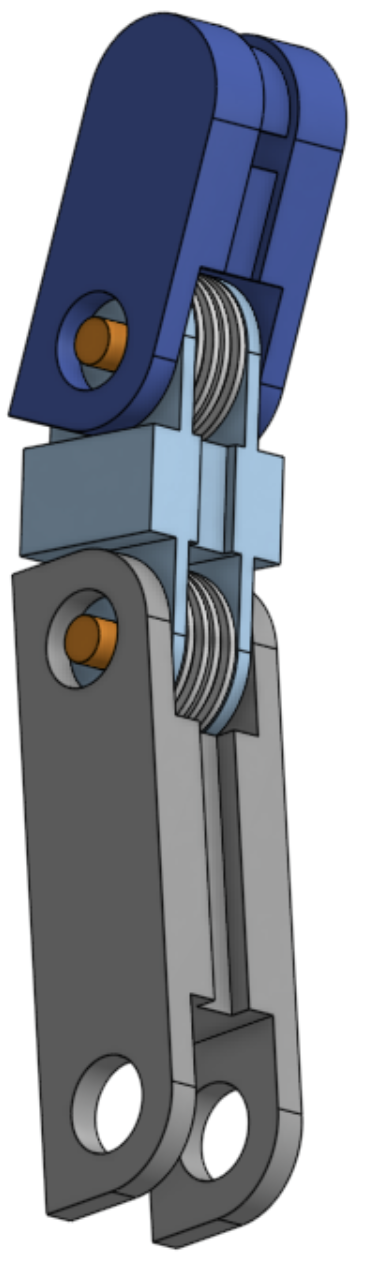
[3 DOF Underactuated]
4-DOF with Splay
This design was an experiment with splay and n+1 tendon routing. While sacrificing compactness, the increased tendon routing pulleys allows for all four degrees of freedom to be individually actuated. This design also experimented with a splay joint at the base of the proximal phalanx. While this splay joint moved smoothly, the size was disproportionately large compared to the rest of the finger.
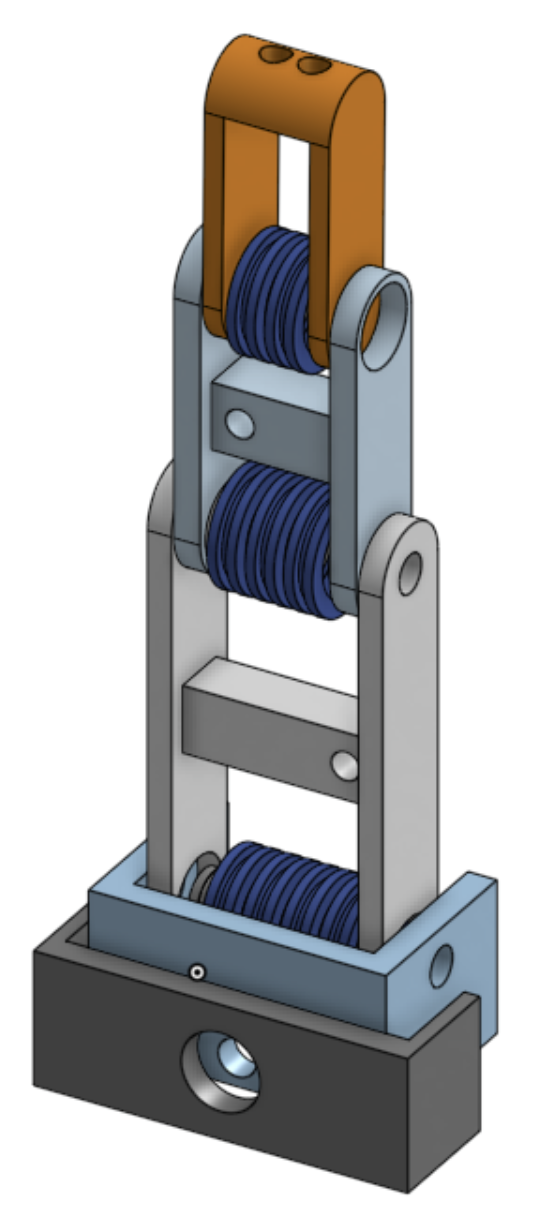
[3 DOF Flexion and Extension, 1 DOF Splay (Abduction/Adduction)]
20-DOF Hand
This hand incorporated the lessons of previous designs into a full hand design, including the n+1 tendon routing pulley, compact design, and splay joints.
In addition to the design strategies used in previous fingers, this design incorporates the following:
- A 4 DOF thumb design with unique degrees of freedom to mimic the range of the human thumb
- Mechanical backstops to prevent the fingers from bending further than fully extended
- Joint covers on the backs of the fingers to cover the tendons and prevent damage throughout the entire range of motion
- Inset tendon routing channels to further prevent interference or damage
- Used smaller bearings and pre-made pulleys to further compact design
- Reduced overall finger length to 90mm (from proximal joint to fingertip), and max width of 18mm (medial joint)
This design has been printed out of PLA with placeholder prints for the bearings and pulleys. While the components fit well and tendon routing functions as intended, some issues with the design were found.
- The splay joints were moved from the base of the proximal phalanx to the base of the metacarpal. This creates a limited range of motion, restriction actions such as crossing the fingers.
- With the placeholder printed bearings and pulleys, noticable friction is present. The steel bearings and pulleys must be purchased and placed into their locations to evaluate the true friction
- The thumb joints are placeholders, and are not reinforced properly to prevent damage during use.
- Some components have weak spots that would be prone to high strain under expected operation. A proper factor of safety analysis needs to be conducted to reinforce the whole design as needed.
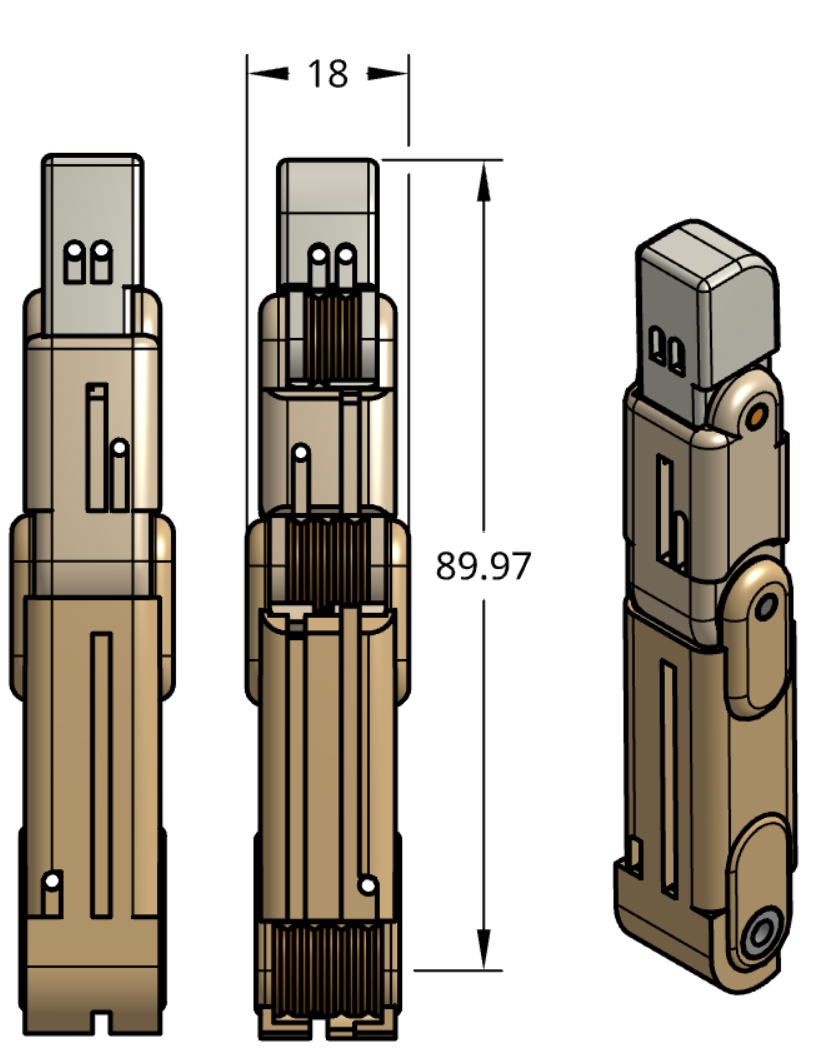
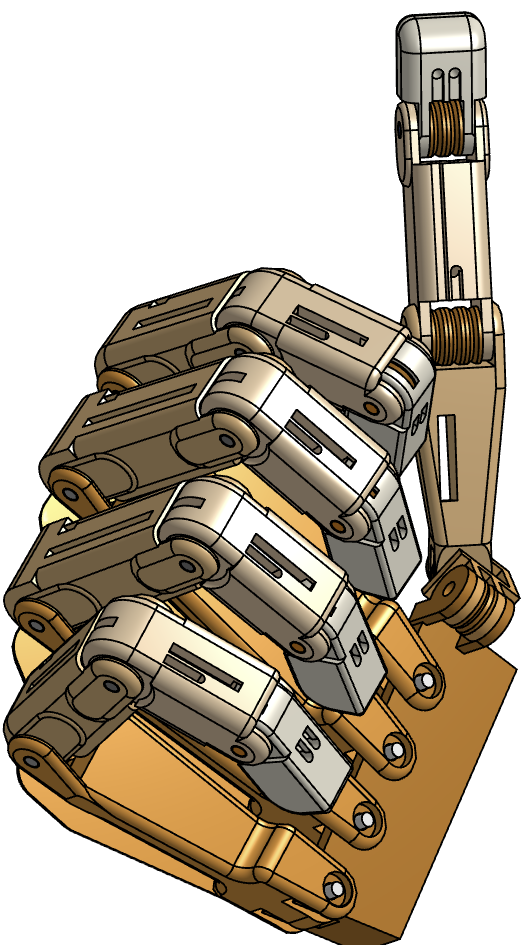
[Single Finger (left), Full Hand (right)]